May 28, 2026
Table of Contents
-Title
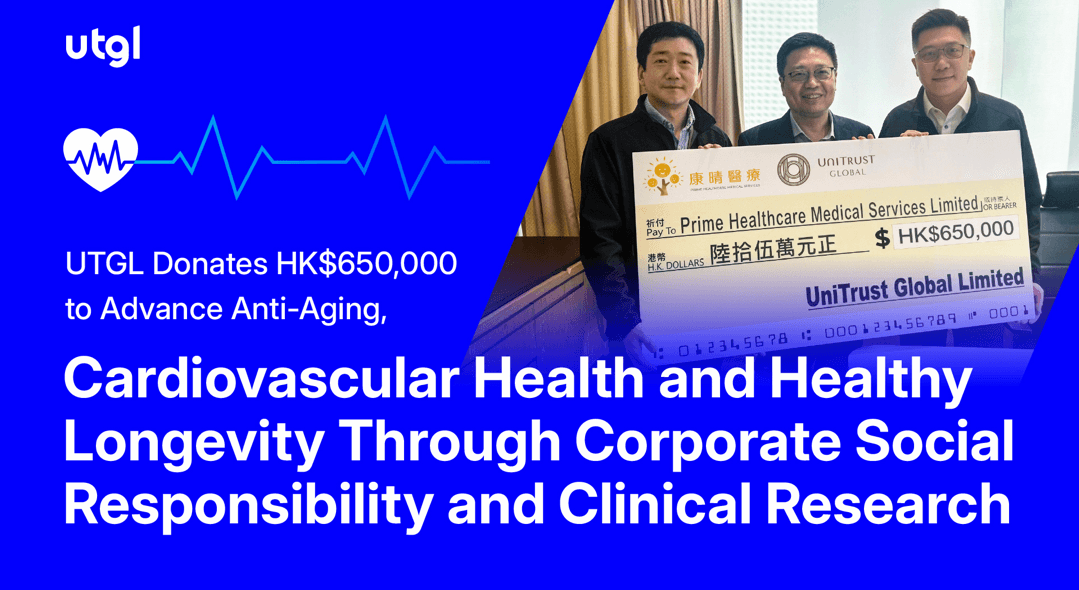
UTGL Donates HK$650,000 to Advance Anti-Aging, Cardiovascular Health and Healthy Longevity Through Corporate Social Responsibility and Clinical Research
Key Takeaways
UTGL’s donation to EECP clinical research highlights its commitment to evidence-based healthcare, blood pressure management, healthy longevity, and community well-being.3
UniTrust Global Limited (UTGL) is pleased to announce that the Company has donated HK$650,000 to Prime Healthcare Medical Services Limited (康晴醫療) to support a clinical trial on Enhanced External Counterpulsation (EECP) and blood pressure management. The related sponsorship date was 25 February 2026, as confirmed by Director Kwong Po Shan of Prime Healthcare Medical Services Limited. Mr. Benjamin Leung, Chief Executive Officer of UTGL, and Mr. Derrick Wong, Managing Director of UTGL, both attach great importance to this collaboration, marking the Company’s concrete action in supporting local medical research, healthy longevity and cutting-edge life science innovation.
As a publicly licensed global private trust services specialist in Hong Kong operating under a government-bonded framework, UTGL understands that corporate value is reflected not only in asset administration and wealth legacy, but also in the ability to translate professional capability, resource allocation and long-term vision into positive social impact.¹ For UTGL, wealth legacy and health legacy are not separate concepts. The long-term well-being, quality of life and sustainable development of families are closely connected with healthspan, chronic disease risk management and medical innovation. Therefore, this donation is not only a sponsorship of cardiovascular research, but also a concrete expression of UTGL’s corporate vision to explore cutting-edge anti-aging and regenerative technologies.
The revised core narrative places the research focus more clearly on hypertension management: the EECP clinical study targets prehypertension and Stage 1 essential hypertension; the research objective is to explore potential improvements in hypertension; and improving hypertension is the starting point for obtaining health signals. In the context of healthy longevity and anti-aging, health signals should not be understood as immediate therapeutic effects or commercial promises. Rather, they are scientific indicators observed through rigorous research that may help understand vascular health, circulatory function, chronic disease risk and quality of life. From this starting point, UTGL seeks to connect blood pressure health with the longer-term vision of healthspan, functional maintenance, anti-aging and regenerative technology.
“We believe that this study targeting pre-hypertension and Stage 1 essential hypertension is not only of meaningful reference value for the early management of chronic cardiovascular risk, but also closely aligns with UTGL’s corporate vision of supporting the improvement of human health and well-being, and exploring cutting-edge anti-aging and regenerative technologies. Improving hypertension is the beginning of obtaining health signals; and health signals provide a more science-based direction for healthy longevity and anti-aging research.”
In the context of modern health management, anti-aging should not be simplified as appearance-based rejuvenation. Rather, it refers to the scientific maintenance of human function, the slowing of functional decline, the reduction of chronic disease risk, and the extension of healthspan. Regenerative technology represents the ongoing exploration within medicine and life sciences of body repair, functional restoration and tissue health. The cardiovascular system is a key foundation of healthy longevity. Vascular elasticity, circulatory efficiency, blood pressure stability and cardiac blood supply directly affect an individual’s physical capacity, quality of life and long-term health risks. For this reason, UTGL views EECP-related research as a responsible scientific exploration that begins with the potential improvement of hypertension, observes health signals, and extends toward a broader vision of healthy longevity and anti-aging, not as a claim of anti-aging efficacy.
Item Details
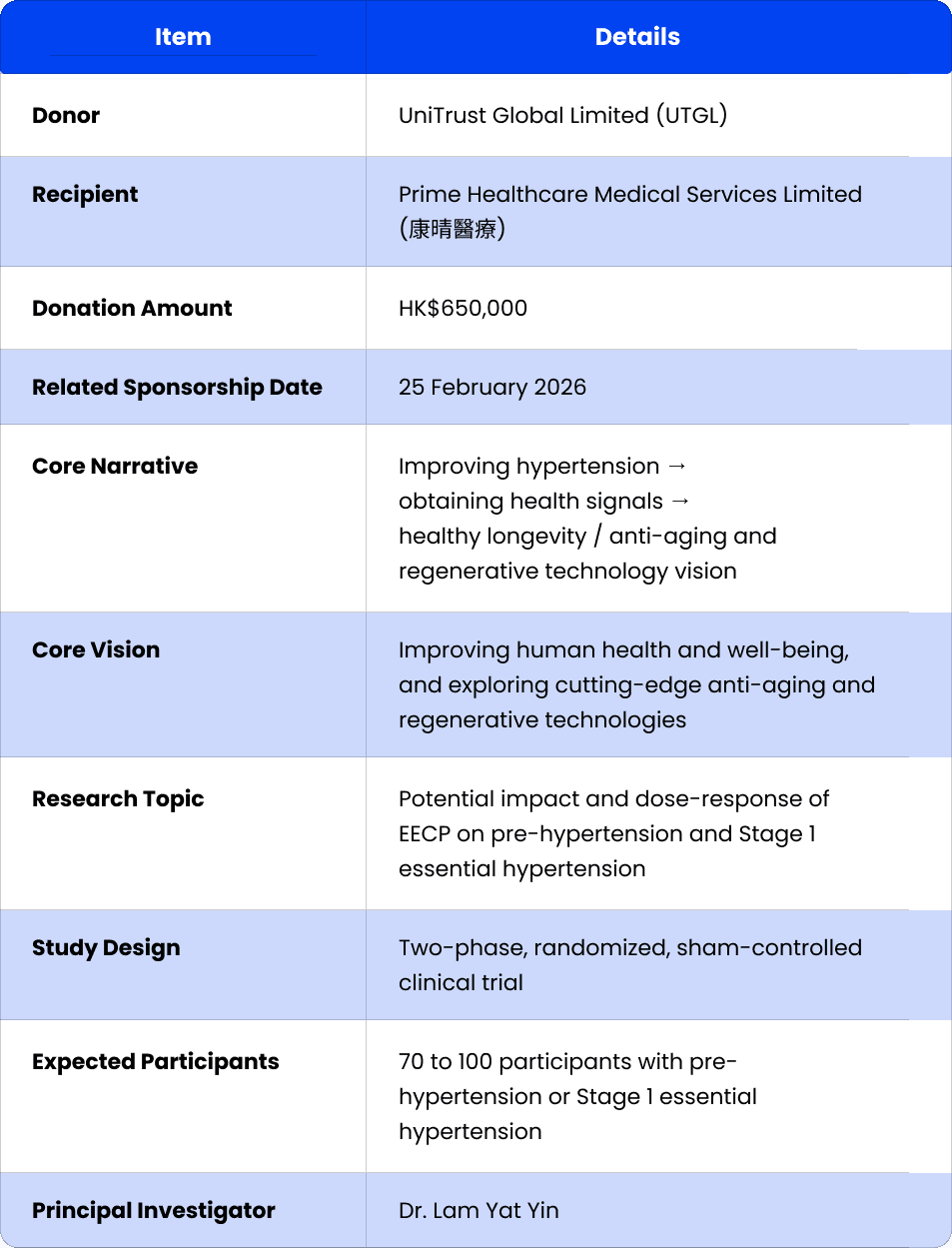
The supported clinical trial is led by Dr. Lam. Dr. Lam is Chairman of Centre Medical Group, Director of Hong Kong Asia Heart Centre, a pioneer in structural heart disease intervention in the Asia-Pacific region, and co-developer of the LAmbre™ Left Atrial Appendage Occluder. The study plans to enrol 70 to 100 participants with pre-hypertension or Stage 1 essential hypertension, using a rigorous randomized and sham-controlled design to evaluate the potential effect and dose-response of EECP intervention on blood pressure control.
EECP is a non-invasive, outpatient external therapy. Its basic mechanism involves pneumatic pressure cuffs placed around the calves, thighs and buttocks, coordinated with electrocardiographic signals and heartbeat rhythm. The cuffs inflate sequentially during cardiac diastole and deflate rapidly before systole, thereby increasing venous return, improving diastolic coronary perfusion and reducing cardiac afterload. Cleveland Clinic describes EECP as an FDA-approved outpatient therapy for chronic stable angina and notes that it uses pressure on the lower limbs to improve blood flow as a non-invasive outpatient treatment.² Medical literature also indicates that EECP may be used in the management of refractory or chronic stable angina, and that studies have shown improvements in angina symptoms, exercise tolerance and quality-of-life-related measures.³
Cleveland Clinic states: “Enhanced external counterpulsation (EECP) treatment is an FDA-approved outpatient therapy for chronic stable angina. It uses pressure on the lower limbs to improve blood flow…”²
It is worth noting that the focus of this study is not simply to repeat the established use of EECP in the field of angina, but to further explore its potential value among individuals with pre-hypertension and Stage 1 essential hypertension. Pre-hypertension and early hypertension often represent a critical window for chronic cardiovascular risk management. If safe, non-invasive and accessible approaches can support lifestyle modification and medical management at an early stage, they may help advance preventive medicine and long-term health management. According to the study protocol, EECP may potentially reduce systolic blood pressure by approximately 6 to 8 mmHg. However, this figure is a study hypothesis or protocol reference and must ultimately be validated through this clinical trial. It does not represent a promise of therapeutic efficacy for any individual.
Existing studies provide important background for this clinical trial. A 2021 study published in Frontiers in Physiology enrolled 40 patients aged 20 to 45 with Stage 1 essential hypertension and randomly assigned them to an EECP group and a control group. The results showed that systolic blood pressure was 133.2 ± 4.9 mmHg in the EECP group and 139.3 ± 6.4 mmHg in the control group, while diastolic blood pressure was 83.4 ± 4.5 mmHg in the EECP group and 89.5 ± 7.6 mmHg in the control group; both differences were statistically significant. The study concluded that EECP reduced systolic and diastolic blood pressure in the studied population and increased FMD, an indicator of vascular endothelial function.4 Because this study had a relatively small sample size and involved a specific population, the findings should be regarded as scientific background supporting further research, not as general treatment advice or a guarantee of therapeutic effect.
Link Between EECP Research and the Healthy Longevity Narrative
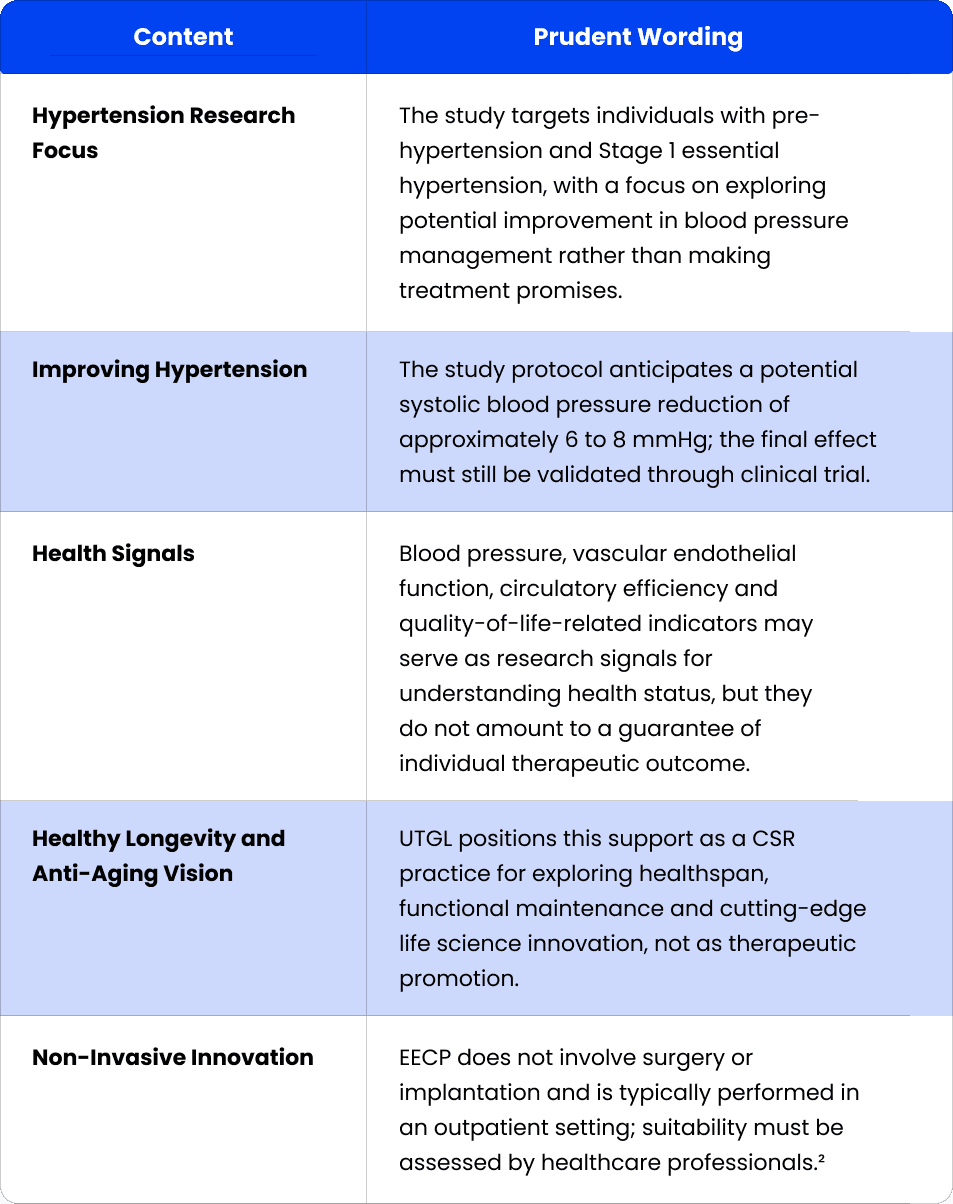
From a CSR perspective, UTGL’s support for this study has three layers of significance. First, it directs corporate resources toward a field with public health value, particularly research related to early hypertension management, chronic disease risk control and the extension of healthspan. Second, it supports Hong Kong medical professionals in generating local clinical evidence through rigorous methodology, reducing society’s reliance on unverified health information. Third, it reflects UTGL’s belief in the connection among improving hypertension, obtaining health signals, health and well-being, anti-aging innovation, regenerative technology and evidence-based research through responsible resource allocation to help build a more resilient health ecosystem.
Mr. Benjamin Leung, Chief Executive Officer of UTGL, stated that the Company has long served families, entrepreneurs and high-net-worth clients, and deeply understands that true wealth legacy extends beyond asset continuity. It also includes values, health and well-being, social responsibility and the quality of life of the next generation. Mr. Derrick Wong, Managing Director of UTGL, also noted that supporting evidence-based medical research is an important way for corporations to give back to society, particularly when the research focuses on early hypertension management, non-invasive approaches, accessibility and healthspan, where the social impact often extends beyond a single medical project.
This donation also demonstrates UTGL’s determination to work with the medical community to advance longevity science and community health. By supporting the EECP clinical study led by Dr. Lam and his team, UTGL hopes to provide more verifiable data for the management of pre-hypertension and early hypertension, while promoting public attention to blood pressure health, cardiovascular health, functional maintenance and healthy aging. In the future, UTGL will continue to select CSR projects in a prudent, long-term and socially beneficial manner, supporting initiatives related to healthcare, education, community and sustainable development, with particular focus on innovative directions that begin with improving hypertension and obtaining health signals, extend healthspan, and advance the exploration of cutting-edge anti-aging and regenerative technologies.
In conclusion, the HK$650,000 donation represents UTGL’s concrete commitment to local medical innovation, preventive medicine, the exploration of anti-aging technology and community well-being. UTGL believes that the long-term success of a company must go hand in hand with societal health, trust and sustainable development. Supporting this EECP clinical study is an important step in translating corporate responsibility into concrete action. We look forward to the research team generating meaningful results within a rigorous ethical and scientific framework, bringing new insights to hypertension management, cardiovascular health, healthspan research and cutting-edge life science innovation in Hong Kong and beyond.
Medical Disclaimer
This article is for corporate social responsibility and research information sharing purposes only. It does not constitute medical advice, diagnosis, treatment advice, promotion of medical services or any guarantee of therapeutic outcome. Whether EECP is suitable for any individual must be assessed by a registered physician or qualified healthcare professional based on the individual’s health condition, cardiovascular risk, medication use and contraindications. The FDA approval or clearance of EECP should not be interpreted as covering anti-aging, life extension, rejuvenation or hypertension treatment. References in this article to the study protocol, potential benefits, health signals, anti-aging narrative and regenerative technology narrative should not be interpreted as guarantees of individual treatment outcomes, life-extension effects, rejuvenation effects, blood pressure reduction or reduced medication use.
References
¹ UTGL | Private Trust Services | Strategic Financial Solutions
² Cleveland Clinic — Enhanced External Counter pulsation (EECP )
³ Sharma, U., Ramsey, H. K., & Tak, T. — The Role of Enhanced External Counter PulsationTherapy in Clinical Practice
⁴ Liang, J. et al. — External Counterpulsation Attenuates Hypertensive Vascular Injury Through Enhancing the Function of Endothelial Progenitor Cells